
CNN on scene in Kyiv after ‘kamikaze’ drones hit Ukrainian capital
03:25
– Source:
CNN
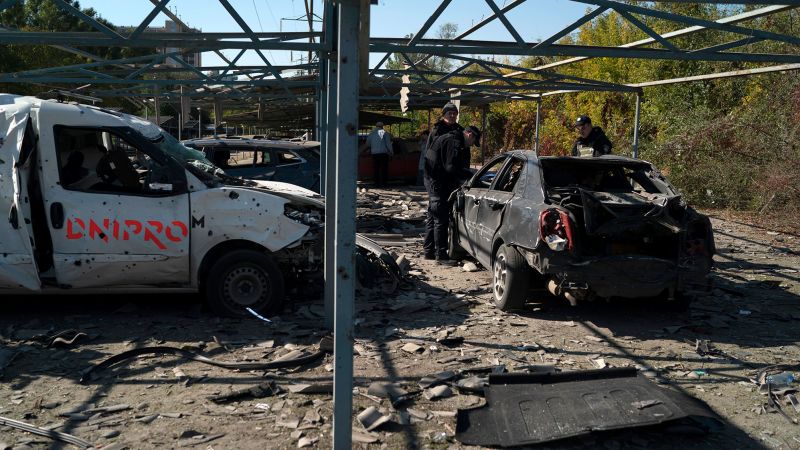
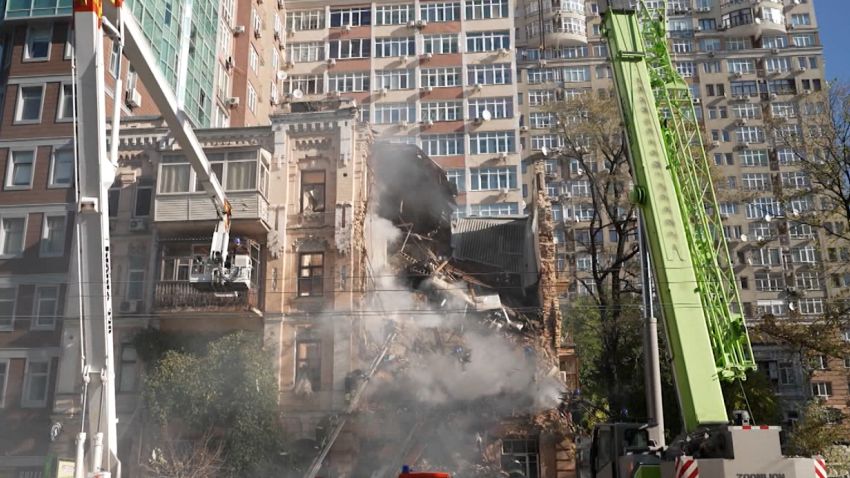
- At least four people were killed after Russia attacked Kyiv with Iranian-made “kamikaze” drones on Monday, according to Ukrainian officials. Among those killed were a pregnant woman and her husband, according to the city’s mayor.
- Ukraine’s foreign minister called for sanctions against Iran at an EU meeting amid more attacks by Iranian-made drones. Tehran has denied supplying weapons to Russia in its war on Ukraine.
- Ukraine and Russian-backed authorities in the eastern Donetsk region exchanged more than 200 prisoners. The swap also featured a meeting between Ukrainian and Russian human rights officials.
- A Russian bomber jet crashed into a residential building in the Russian city of Yeysk, officials said.

Dmytro Lubinets, the Ukrainian Parliament Commissioner for Human Rights, left, meets with Tatyana Moskalkova, Russian Human Rights Commissioner, during an exchange of more than 200 prisoners of war.
In a first, Ukrainian and Russian human rights officials met Monday during a prisoner exchange between the two sides.
Dmytro Lubinets, the Ukrainian Parliament Commissioner for Human Rights, met with Tatyana Moskalkova, Russian Human Rights Commissioner, during the swap of more than 200 prisoners of war.
Moskalkova posted video of the meeting on Telegram. It is unclear where exactly the exchange took place.
In the video, Lubinets and Moskalkova approach each other on a deserted highway, shake hands, and have a brief exchange.
“Today is the day that our civilian sailors will be coming home,” Moskalkova told Lubinets. “It’s also important that we ensure that safe corridors exist for our work with the evacuated. We have a Iot of questions, but the most important is returning all their documents to them. So that’s what I am coming to you today for, and I’m here to help in the case that an evacuee or refugee needs a specific document or confirmation of their identity.”
“It’s an important humanitarian aspect in terms of social rights,” she said.
Lubinets replied that “we are exchanging lists, and I request that you will work through it and be in touch on what’s possible.”
“Most importantly, we have activated the process of exchanging civilians of our countries. I’m sure that you want this as much as we do.”
Moskalkova said that “certainly everyone is interested in this path forward.”
In a summation of the meeting posted on Telegram, Moskalkova said that she “met for the first time with Commissioner for Human Rights of Ukraine Dmitry Valeryevich Lubinets. We had a constructive dialogue and agreed to continue working to ensure the proper treatment of prisoners, keep working for future exchanges, to protect the rights of civilians, and learn the fate of missing persons.”
Lubinets, on his Telegram account, said that “the need for negotiations is the humanitarian sphere.”
“In particular, we talked about the need to intensify the repatriation of prisoners of war and the release of civilian hostages,” he said.
He said that the two discussed, among other things, the need to “develop ways to visit prisoners of war, inspect places of their detention, both on the territory controlled by the Russian Federation and in Ukraine” and “thorough searches for missing persons.”
They also discussed Ukraine’s desire to visit prisoners of war held in Olenivka, which is in an occupied portion of the Donetsk region.
“At the end of the meeting, it was agreed to send official letters for the implementation of the discussed tasks involving the protection of human rights,” Lubinets said.
Ukrainian President Volodymyr Zelensky on Monday hailed an exchange of more than 200 prisoners by Russia and Ukraine.
Among those released by Russian and pro-Russian forces, he said, were people who had been detained since before Russia’s full-scale invasion in February.
“We do not forget about any of our people,” he said. “We must return them all. And we will.”
“I thank all those involved for this success, and I also thank all those who replenish our exchange fund, who ensure the capture of the enemy,” he added.
A Russian drone attack on the Ukrainian capital Monday morning killed a woman who was 6 months pregnant and her husband, according to Kyiv’s mayor.
In reaction, President Volodymyr Zelensky said:
“The world can and must stop this terror,” Zelensky said. “When we talk about Ukraine’s need for air and missile defense, we are talking about real lives that are taken by terrorists.”
He said that though Ukraine has been successful in shooting down Iranian-made Shahed drones, it was not enough.
“In order to guarantee the protection of our skies and reduce to zero the capabilities of Russian terrorists, we need much more modern air defense systems and more missiles for such systems,” he added.

White House press secretary Karine Jean-Pierre speaks during the daily news briefing at the White House in Washington, DC, on Monday.
White House press secretary Karine Jean-Pierre condemned Russia’s latest attacks on Kyiv, Ukraine. While she would not say whether the Biden administration believes the war is entering a new phase, she did describe the last few weeks as an “escalation.”
“I’m not going to go into any analysis on where we are in this war, we have been very clear about how we — how we’ve been seeing Russia’s escalation over the past several weeks,” Jean-Pierre told CNN’s MJ Lee.
She also again noted that the administration is in daily contact with the Ukrainians and she pointed to the latest security package the US has announced for Ukraine, adding: “The most recent escalation, the United States strongly condemns Russia’s missile strikes today which continue to demonstrate Putin’s brutality.”

Members of a forensic team during an exhumation at a mass grave in Lyman, Ukraine, on Tuesday.
Police in the eastern Ukrainian region of Donetsk says that they continue to exhume up to 10 to 15 bodies per day in previously Russian-occupied areas of the region.
“By now, 43 mass graves are known in Donetsk oblast,” Oleksandra Havrylko, press officer for the Donetsk Oblast Police, said during a media briefing. “For example, two mass graves — with both civilians and military — were found in Lyman. Moreover, the Oblast Police receives information about spontaneous burials in human yards, where each grave may contain up to 10 people.”
Many people are believed to have died of injuries from explosives, Havrylko said, but the police also have information about citizens “who were killed through violence.”
Exhumations in Lyman have so far revealed 35 members of the military and 152 civilians, Havrylko said. He said that 40 hard-to-reach graves have yet to be exhumed.
The Kyiv region’s air defense is actively responding to a Russian drone attack, the mayor of Boryspil on the outskirts of Kyiv city said Monday evening.
“Air defense system is working above our city so I strongly recommend everyone to stay in shelters,” Volodymyr Borysenko said on Facebook. “Situation is under control. Our Armed Forces are doing their job well. But the threat remains.”
“The bright strip of light is our military trying to see the enemy drones, so don’t panic. Stay in shelters,” the mayor added.
Moscow’s strikes on Kyiv: At least four people were killed after Russia attacked the capital of Kyiv with Iranian-made “kamikaze” drones on Monday, according to Ukrainian officials, who have repeated their calls for Western allies to supply Ukraine with more advanced air defense systems.
Ukraine’s interior minister said Kyiv’s security forces were able to shoot down 36 of 42 attack drones that Russia launched on Monday.
“It shows that this attack has not reached its goal. I think that the goal was to outdo the last Monday missiles attack. But this did not happen today,” Denys Monastyrskyi told Ukrainian television.
Of those 42 drones, around 30 targeted Kyiv, he said, adding that the others targeted the Sumy and Dnipropetrovsk regions.
The Ukrainian government and Russian-backed authorities in eastern Ukraine’s Donetsk region each freed more 100 prisoners on Monday in a swap.
The Russian-backed side released 108 Ukrainian women, both military and civilian, according to Ukraine’s Coordinating Headquarters for the Treatment of Prisoners of War. Among the released Ukrainians are members of the Armed Forces, servicewomen in the Navy, National Guard and Border Guard. The Russian-backed authorities also released 12 Ukrainian civilians.
“It was a very nerve-wracking exchange,” Andrii Yermak, head of the Office of the President of Ukraine, said on Telegram.
Meanwhile, the Ukrainian government released 110 people, among them 80 civilian sailors and 30 servicemen who serve on behalf of Russia, according to Denis Pushilin, the Russian-backed leader in Ukraine’s Donetsk region, which Russia now claims to be part of its country.

Fire caused by a Russian jet that crashed into a residential building in the city of Yeysk, Russia, on Monday.
A Russian Su-34 supersonic fighter-bomber jet crashed into a residential building in the city of Yeysk on Monday, the Russian state media TASS reported.
The crash was due to ignition of one of the engines, Russian state media RIA Novosti reported citing the country’s defense ministry.
It is not clear how many people were in the fighter jet.
“On October 17, 2022, a Su-34 aircraft crashed while climbing to perform a training flight from the military airfield of the Southern Military District,” the ministry said in a statement to RIA. “According to the report of the ejected pilots, the cause of the plane crash was the ignition of one of the engines during take-off. At the site of the crash of the Su-34 in the courtyard of one of the residential quarters, the plane’s fuel ignited.”
The area of the fire that started after the crash is 2,000 square meters, the Russian Ministry of Emergency Situations told RIA.
The information about casualties in the area is being established, according to the ministry.
Veniamin Kondratyev, the governor of Krasnodar Krai region, is on his way to the city, he said in a statement on his Telegram channel.
“Emergency services are already working on the spot — all regional fire and rescue garrisons are engaged in extinguishing the fire,” he added.
The state media reported that another resident of the city specified that this residential building has nine floors. The entire house is on fire, according to the eyewitnesses, as quoted by TASS.
Yeysk is located across the water from the Russian-occupied city of Mariupol.
An adviser in Ukrainian President Volodymyr Zelensky’s office has called for Russia to be expelled from the G20 forum of leading nations.
“Those who give orders to attack critical infrastructure to freeze civilians and organize total mobilization to cover the frontline with corpses, cannot sit at the same table with leaders of G20 for sure,” Mykhailo Podolyak, adviser to the head of the President’s office, said on Twitter.
Some more context: Russia was expelled from the G8 in 2014 over its annexation of Crimea. The G20 is set to meet in Bali, Indonesia, next month. The Kremlin has not yet confirmed whether President Vladimir Putin will attend, but said that Russia will participate.
See Podolyak’s tweet:

Relatives say goodbye to Russian citizens drafted during the partial mobilization as they depart to their military units in Moscow, Russia, on September 29.
Moscow mayor Sergei Sobyanin announced on Monday the end of partial mobilization in the city and the closing of the military draft offices at 2 p.m. local time on Monday, according to the statement published online.
“According to the information of the military commissar of Moscow, the tasks for partial mobilization, established on the basis of the Decree of the President and the assignment of the Ministry of Defense, have been completed in full,” Sobyanin said in a statement.
“Military draft offices will close on October 17, 2022, at 14:00. Summons sent in the process of mobilization to the place of residence and enterprises cease to be valid,” the statement said.
More on Russia’s mobilization order: Last month, Russian President Vladimir Putin announced the immediate “partial mobilization” of Russian citizens on Wednesday, a move that threatened to escalate his faltering invasion of Ukraine following a string of defeats that caused recriminations in Moscow.
Putin said in a speech that he would use “all the means at our disposal,” and even raised the specter of nuclear weapons, if he deemed the “territorial integrity” of Russia to be jeopardized.
Kyiv’s security forces were able to shoot down 36 of 42 attack drones that Russia launched on Monday, Ukraine’s interior minister said on Monday.
“It shows that this attack has not reached its goal. I think that the goal was to outdo the last Monday missiles attack. But this did not happen today,” Denys Monastyrskyi told Ukrainian television.
Of those 42 drones, around 30 targeted Kyiv, he said, adding that the others targeted the Sumy and Dnipropetrovsk regions.
At least one drone in Kyiv was brought down by small arms fire from police officers, he added.
However, he warned that the chance of shooting down a drone with small arms fire is quite low with a high risk.
“I would like address those citizens who have firearms in their possession: shooting from a rifle or a gun from the high-rise building might cause more damage than a chance to shot down a drone,” he said.

A police expert holds a fragment of a drone with a handwritten inscription reading “For Belgorod. For Luch” after a drone attack in Kyiv on October 17. Image has been blurred by CNN because the identifier could help Russian targeting.
A drone used by Russia to attack the Ukrainian capital Kyiv on Monday had the phrase “for Belgorod” written on one of its vertical stabilizers.
The phrase appears to be a reference to explosions in recent weeks in Russia’s Belgorod region, which borders Ukraine near the city of Kharkiv. Ukraine has not commented on those incidents.
The drone is the Iranian-manufactured Shahid-136, which is rebranded under the Russian name “Geran 2.”
The stabilizer was photographed this morning by an AFP photographer. It also appeared in a video posted on Telegram by Anton Gerashchenko, an adviser to Ukraine’s minister of internal affairs.
The drone also included the phrase “for Luch” that appears to be a reference to a reported power plant fire last week in the Belgorod region.
Russian and Belarusian troops have “begun to deploy and carry out tasks for the armed defense” of Belarus, according to Belarusian Defense Minister Viktor Khrenin, Belarusian state media BELTA reported on Monday.
“Today, based on the current situation, we are acting in stages, implementing individual measures aimed at proactive readiness of the regional grouping to respond to emerging challenges and threats,” Khrenin said at a meeting with the staff of one of Belarus factories, as quoted by BELTA.
“The regional grouping of troops and forces itself is a complex organism of many components. It includes command and control bodies at various levels, and troops, and forces, as well as various support systems, both Belarusian and Russian,” he added.
According to Alexander Volfovich, state secretary of the Security Council of Belarus, the regional grouping of troops on the territory of the republic is deployed in an incomplete composition.
“In the future, life will show whether to deploy it on a full scale or not,” said Volfovich, as quoted by BELTA.
On Monday, Valery Revenko, head of the international military cooperation department of Belarus Defense Ministry, said in a tweet that Russia plans to send about 170 tanks, up to 200 armored combat vehicles and up to 100 guns and mortars with a caliber of more than 100 mm to Belarus as part of the deployed Belarusian-Russian group of troops.
“Belarus to receive 9,000 personnel, about 170 tanks, up to 200 AFVs and up to 100 guns and mortars with a caliber of more than 100 mm,” Revenko said on Twitter.
President of Belarus Alexander Lukashenko announced on Oct. 10 that Belarus agreed to deploy a joint regional grouping citing “the aggravation of the situation on the western borders of the Union State.”
Germany announced it will end its program that offered Ukrainian refugees the ability to exchange Ukrainian hryvnia banknotes to euros without exchange rates.
The program will end by Oct. 30, a joint statement from the German finance ministry and central bank said on Monday.
The provision was initially introduced to help Ukrainian refugees who fled the country after Russia’s invasion, but that the demand has “dwindled,” the statement said, adding that few transactions have recently taken place.
The statement added that the last day to exchange between currencies is Oct. 28, due to banks being closed over the weekend.

Kyiv mayor Vitali Klitschko speaks to the press next to a destroyed building after a drone attack in Kyiv, Ukraine, on October 17.
The number of people killed after Russian strikes in the Ukrainian capital, Kyiv, has now reached four, the city’s mayor said Monday.
“We’ve got already 4 people dead under the ruins of the building in the Shevchenkivsky district which was hit by the Russian terrorist drone,” Vitali Klitschko said on Telegram. “The rescuers found another body of a man there. The rescue operation is ongoing. There could be some other people under the rubble.”
Three people have been taken to the hospital, he said, two of whom are emergency responders.
CNN’s Olly Racz contributed to this report.

Russian-Belarusian exercises, dubbed Allied Resolve 2022, in Belarus on February 19.
The announcement last week that Belarus and Russia would form a joint regional force and carry out exercises set off alarm bells in Kyiv.
The last time Belarusian and Russian forces held joint exercises, in February, many of those Russian forces went on to cross the Ukrainian border in their ill-fated drive toward the capital.
It’s not that Belarus has a mighty army – it doesn’t. But the prospect of Ukraine’s long northern border becoming a passageway for Russian forces for the second time this year would be a nightmare for Ukraine’s already stretched forces. Ukraine and Belarus share a 1,000-kilometer frontier, much of it sparsely populated and thickly forested.
At the moment, the Ukrainian army is conducting offensives in the east and south while holding off Russian forces in parts of Donetsk and Zaporizhzhia. After seven months of war, the Ukrainian military has suffered attrition just like its enemy: moving forces to defend its northern flank would stretch forces already fighting on multiple fronts.
Predictably enough, Belarus says the joint force is purely defensive. The country’s Defense Minister Viktor Khrenin said that “all activities carried out at the moment are aimed at providing a sufficient response to activities near our borders.”
Those activities, according to Belarus, are aimed at deterring Ukrainian preparations to attack the country. Lukashenko said last week that his government had been “warned about strikes against Belarus from the territory of Ukraine.”
Ukraine has vehemently denied the claims. The Foreign Ministry said it “categorically rejects these latest insinuations by the Belarusian regime. We cannot rule out that this diplomatic note may be part of a provocation on the part of the Russian Federation.”
Read the full analysis here.

A fragment of a kamikaze drone after the Russian attacks in Kyiv, Ukraine, on October 17.
Ukraine has repeatedly asked its allies to supply it with more air defense systems and ammunition after Russia stepped up its use of “kamikaze drones” in its brutal assault against the country.
Kyiv says Moscow has used Iranian-supplied kamikaze drones in strikes against Kyiv, Vinnytsia, Odesa, Zaporizhzhia and other cities across Ukraine in recent weeks, and pleaded with Western countries to step up their assistance in the face of the new challenge.
Drones have played a significant role in the conflict since Russia launched its full-scale invasion of Ukraine in late February, but their use has increased since Moscow acquired the new drones from Iran over the summer.
What are kamikaze drones? Kamikaze drones, or suicide drones, are a type of aerial weapon system. They are known as a loitering munition because they are capable of circling for some time in an area identified as a potential target and only striking once an enemy asset is identified.
They are small, portable and can be easily launched, but their main advantage is that they are hard to detect and can be fired from a distance.
Why are they called “Kamikaze”? The name “kamikaze” refers to the fact that the drones are disposable. Unlike more traditional, larger and faster military drones that return to base after dropping missiles, Kamikaze drones are designed to crash into a target and explode, detonating their warhead and destroying the drones in process.
Which drones is Russia using in Ukraine? The Ukrainian military and US intelligence say Russia is using Iranian-made attack drones. US officials told CNN in July that Iran had begun showcasing Shahed series drones to Russia at Kashan Airfield south of Tehran the previous month. The drones are capable of carrying precision-guided missiles and have a payload of approximately 50 kilograms (110 pounds).
In August, US officials said Russia had bought these drones and was training its forces how to use them. According to Ukraine’s President Volodymyr Zelensky, Russia has ordered 2,400 Shahed-136 drones from Iran.
Iran has denied supplying weapons to Russia: But evidence points to the contrary. Ukraine claimed its forces had shot down one of these drones for the first time last month near the city of Kupyansk in Kharkiv. There have been more reported attacks since then. Kyiv’s military said Wednesday it had downed 17 Shahed-136 drones that day alone. According to photos released by Ukrainian authorities, Russia has rebranded the Shaheds and is using them under the name of “Geran.”
US officials say there has been “some evidence already” that the Iranian drones “have already experienced numerous failures” on the battlefield.
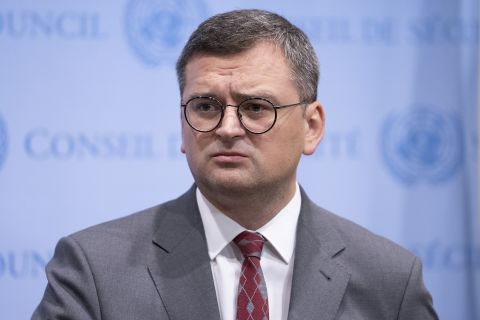
Minister of Foreign Affairs of Ukraine Dmytro Kuleba during the press conference ahead of Security Council meeting on situation in Ukraine at UN Headquarters, in New York, on September 22.
Ukraine’s foreign minister said “the patience broke,” as he explained why he called for sanctions against Iran on Monday at an EU meeting after dozens of Iranian-made drones struck across the country and the capital city of Kyiv, killing at least three people.
“Today, for the first time in the history of Ukrainian-Iranian relations, I called for sanctions against Iran,” Foreign Affairs Minister Dmytro Kuleba said in the video statement on his Facebook page.
“The patience broke. We listened to various explanations and arguments for a very long time, but it’s impossible to hide the truth. And this truth today flew into the houses of the city of Kyiv. Therefore, the time has come to apply sanctions against Iran for the supply of weapons to the Russian Federation,” Kuleba said.
The foreign minister said sanctions against Iran would send a message that anyone helping Russia will “suffer and feel the price of it.”
Earlier Monday, EU Foreign Policy Chief Josep Borrell said that the EU “will look for concrete evidence” on Iran’s involvement in the war in Ukraine, ahead of today’s scheduled meeting of EU foreign ministers in Luxembourg.

Firefighters work on a building in Kyiv, Ukraine, on October 17, after a Russian drone attack.
As Ukraine’s capital city of Kyiv has come under attack by so-called “kamikaze” drones, according to a top Ukrainian official, the Biden administration will factor in Russia’s use of these deadly drones in its future decision-making and planning as it pertains to helping Ukraine, according to a senior administration official.
That decision-making notably includes ongoing deliberations about providing Ukraine with air defense systems, which is Kyiv’s top need at this point in the war as Ukrainian officials have repeatedly said.
In recent days, US President Joe Biden and top US officials have made clear that the US plans to continue providing Ukraine with various air defense systems – including the expedited delivery of two NASAMS systems.
While the US is certain that Russians are in fact using these “kamikaze” drones and that they are lethal, the senior administration official also told CNN Monday, for now, the administration will let the Ukrainians describe and characterize how much harm attacks from those drones have caused on the ground.
As Moscow escalates its assault on Ukraine, emergency services are working to rescue people from fatal “kamikaze” drone attacks launched by Russia early Monday.
Here are the latest developments:
- Drone strikes rock Kyiv: A pregnant woman is among three people killed in a spate of “kamikaze” drone attacks targeting the Ukrainian capital city, according to local authorities. Kyiv and US intelligence say Moscow used weapons supplied by Iran, a claim Tehran vehemently denies.
- EU to investigate Iran’s ties with Moscow: The European Union “will look for concrete evidence” on Iran’s involvement in Russia’s military assault on Ukraine, the bloc’s foreign policy chief, Josep Borrell, said Monday.
- Moscow targets Ukrainian energy infrastructure: Russia’s defense ministry said Monday that its forces launched massive high-precision strikes on military targets and energy infrastructure facilities across Ukraine, with the Ukrainian prime minister urging residents to minimize their electricity consumption.
- Ukraine-Saudi relations at critical juncture: Relations between Ukraine and Saudi Arabia are “strengthening,” Ukrainian President Volodymyr Zelensky said Sunday. His comments came after Crown Prince Mohammed bin Salman pledged $400 million in humanitarian aid to Ukraine.
At least three people were killed, nine injured and others remain trapped in the rubble after rocket attacks on critical infrastructure in Ukraine’s northeastern Sumy region, according to the regional head of the military administration.
“At 5:20 in the morning, three Russian rockets hit the civil infrastructure facility. At least three people died. Nine are wounded. There are still people under the rubble,” Dmytro Zhyvytskyi, the head of the Sumy region military administration, said on Telegram.
Electricity was also impacted and 1,625 subscribers were disconnected from the electricity supply in the Sumy region, Zhyvytskyi said.
He urged people to minimize electricity use during peak hours.

The United Russia Party Leader Dmitry Medvedev speaks during the Congress of The United Russia Party, on December 4, in Moscow, Russia.
Dmitry Medvedev, the deputy head of Russia’s Security Council and former Russian president, has warned Israel against supplying military weapons to Ukraine.
“Israel seems to be planning to supply weapons to the Kyiv regime. A very reckless move. It will destroy all interstate relations between our countries,” Medvedev said in a Telegram post, without providing more details.
CNN reached out to the Israeli prime minister’s office for a response but they had no comment to Medvedev’s claims.
Some background: Nachman Shai, Israel’s minister of diaspora affairs — whose agenda does not include military policy – tweeted Sunday, in support of sending military aid to Ukraine.
“This morning it was reported that Iran is transferring ballistic missiles to Russia. There is no longer any doubt where Israel should stand in this bloody conflict. The time has come for Ukraine to receive military aid as well, just as the USA and NATO countries provide,” he said.
Remember: Although Israel has officially condemned the invasion and regularly sends aid to Ukraine, it has not yet sent any weapons to Kyiv, and has been criticized for not being more forceful in its criticism of Russia.

Marina Ovsyannikova speaks to journalists as she arrives for a hearing in a court in Moscow, Russia, on July 28.
Marina Ovsyannikova, the Russian journalist who held up an anti-war poster on Russian state TV earlier this year, has fled Russia and is now under protection of a European country, Russian state media RIA Novosti reported Monday citing a comment from her lawyer Dmitry Zakhvatov.
“Marina Ovsyannikova was forced to leave Russia,” said Zakhvatov, adding that the journalist is now “under the protection of one of the European countries.”
Ovsyannikova was charged according to the Russian criminal code with disseminating false information about the Russian military after participating in a protest in July, which could lead to punishment of up to 10 years in prison.
In early October, she was placed on the Russian Ministry of Internal Affairs’ “wanted list.”
A six-month pregnant woman was one of the people killed in a drone strike on a residential building in Kyiv, according to the city’s mayor.
“The bodies of three dead civilians were pulled out during search and rescue operations in a residential building in the city center, hit by a Russian drone. Among them is a young couple, a husband and wife, who were expecting a child. The woman was 6 months pregnant,” Vitalii Klitschko said in a statement on Telegram.
Moscow launched drone attacks on residential buildings early Monday in Kyiv. Ukraine and US intelligence claimed that Russia used Iranian-supplied “kamikaze” drones to hit multiple regions in Ukraine, which Tehran has repeatedly denied.
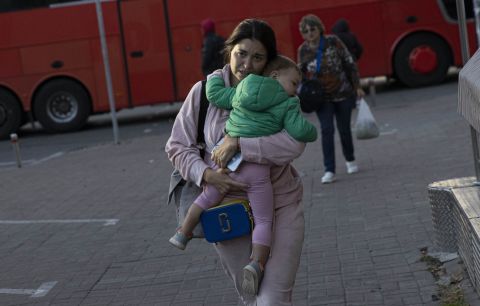
A Ukrainian woman is seen with her child after the Russian attacks in Kyiv, Ukraine on Monday.
Civilians were “running” and “screaming” amid deadly drone attacks launched by Russia across Kyiv early Monday, according to an eyewitness at the scene.
Vitalii, a man in his 20s, told CNN he was at a train station when the deadly strikes hit the Ukrainian capital city. He declined to give CNN his last name due to security concerns.
Vitalii said he saw “Shahed” drones flying overhead — the name given to Iranian-made “kamikaze” drones that Kyiv and US intelligence claim Moscow is using in their military assault on Ukraine.
“We were at the railway station (during the attack), we just arrived. We just got off the train and saw this Shahed flying over us. We saw a flash and an explosion,” he said.
“We went to the basement, and when we got out, we saw a second hit over there, where there is smoke now. We had been staying in the basement for about two hours, and then there was another explosion. When it was quiet, we took a taxi and left.
“People first started coming out of the basement. After, when there was another explosion, everyone went back to the basement. People were running, screaming. There was panic. People were scared because they didn’t understand what was going on.”
He added: “We have seen the explanation in internet about how it (‘Shahed’) works, it buzzes. We have heard, seen it. It flew just above us — a triangular one. And it exploded.”
Anna works in a local coffee shop close to where the attack took place. She declined to give CNN her last name due to security concerns.
“I learned about the attack from the news. At first I decided not to go work, so I arrived only around 10:30 a.m. (local time),” she told CNN.
“It was scary, but not as scary as at the beginning of the war. That is, we are somehow used to it.
“I had a feeling this morning that something was going to happen, because I was here last Monday, I saw what happened. Thank God, I wasn’t here at the moment when everything happened.
“Last week we did not work because of this situation because we were afraid of new attacks. Today I really start thinking, whether it is safe,” she added,
“I’m scared, but it’s hard to believe that it (drone or rocket) could fly here.”
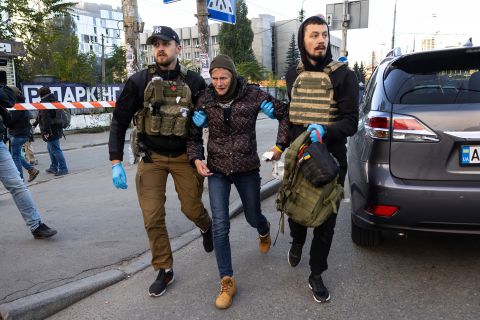
A woman is rescued as Ukraine’s capital is rocked by explosions during a drone attack in the early morning on Monday in Kyiv, Ukraine.

Smoke rises as Ukraine’s capital is rocked by explosions during a drone attack in the early morning on Monday, October 17, 2022 in Kyiv, Ukraine.
Russia’s defense ministry said on Monday that its forces launched massive high-precision strikes on military targets and energy infrastructure facilities across Ukraine.
“During the day, the Russian armed forces continued to strike with high-precision long-range air and sea-based weapons at military command and control facilities and the energy system targets of Ukraine. All designated objects were hit,” the ministry said in a statement.
Drone attacks launched by Moscow on residential buildings early Monday have killed at least three people in Kyiv, a senior Ukrainian official has said, with search and rescue operations still underway.
Kyiv and US intelligence claimed that Russia used Iranian-supplied “kamikaze” drones to hit multiple regions in Ukraine, which Tehran has repeatedly denied.

European Commission vice-president Josep Borrell speaks to journalists as he arrives at the European Council in Brussels, Belgium, on October 3.
The European Union “will look for concrete evidence” on Iran’s involvement in Russia’s military assault on Ukraine, according to the bloc’s foreign policy chief.
Russia is “more and more isolated” and is “losing this war,” Josep Borrell said as he arrived in Luxembourg for a meeting with EU foreign ministers on Monday.
When asked about Iran’s involvement in the war in Ukraine, Borrell said: “This is something that will be discussed … and we will look for concrete evidence about the participation (of Iran).”
EU foreign ministers are due to discuss “peace facility, military support” and a “training mission” to support Ukraine, Borrell added.
Iran has repeatedly rebuffed claims from Kyiv and US intelligence that it is supplying “kamikaze” drones for Moscow’s war on Ukraine.
The denials from Tehran follow a string of deadly drone attacks launched by Russia across Ukraine Monday.

A drone flies over Kyiv, Ukraine, during an attack on October 17.
Moscow carried out attacks on crucial energy facilities in three Ukrainian regions and disrupted power in some areas on Monday, Ukraine’s prime minister has said.
“In particular, 5 drone strikes were recorded in Kyiv. Energy facilities and a residential building were damaged,” Denys Shmyhal said on Telegram.
“The aggressor also launched rocket attacks on critical infrastructure in the Dnipropetrovsk and Sumy regions. Hundreds of settlements were cut off as a result of the attack.”
The attack on energy infrastructure in the Kamianske district of the Dnipropetrovsk region caused “fire” and “serious destruction,” according to regional military official Valentyn Reznichenko.
The prime minister urged all Ukrainians to minimize their electricity consumption, as authorities work to stabilize utility services.
“Currently, all services are working on eliminating the consequences of shelling and restoring electricity supply. Each region has a crisis response plan,” Shmyhal added.
“We ask Ukrainians, in order to stabilize the energy system, to take a united and conscious approach to economical consumption of electricity. Especially during peak hours.”
Ukraine’s state energy supplier Ukrenergo said the power grid in the country remains “under control,” adding that repair crews are working to curb the consequences of the attacks.
Ukrenergo did not rule out the possibility of introducing emergency shutdown schedules.
Shmyhal’s announcement comes as Ukraine grapples with sweeping attacks on critical energy facilities, following deadly Russian strikes over the past week.

Firefighters attend a residential building destroyed by a Russian drone strike in Kyiv, Ukraine, on October 17.
Three people were killed and 19 people have been rescued following a spate “kamikaze” drone attacks targeting Kyiv on Monday, according to a senior Ukrainian official.
“As of now, the number of people killed as a result of a kamikaze drone attack on a residential building has increased to 3. 19 people have been rescued,” Kyrylo Tymoshenko, deputy head of the president’s office, said on Telegram.
Search and rescue operations are ongoing in the Ukrainian capital as emergency services work to retrieve people from underneath the rubble.

Smoke rises over the street after a drone attack in Kyiv, Ukraine, on October 17.
One woman has died and another person remains beneath the rubble at the site of a fatal drone attack in Kyiv on Monday, according the city’s mayor.
“The body of a dead woman was pulled out from the rubble in the house in Shevchenkivskyi district, where there was an explosion as a result of a drone attack,” Vitali Klitschko said on Telegram. “Another person is under the rubble.”
Three people have been hospitalized, Klitschko added.
Moscow launched a fresh round of deadly “kamikaze” drone attacks across Ukraine early Monday, with weapons that Kyiv and US intelligence say were supplied by Iran.
Search and rescue operations at the site of the attacks are ongoing.
Iran has again refuted claims that it is supplying weapons to Russia for Moscow’s war on Ukraine.
“Iran has repeatedly declared that it is not a party in the war between Russia and Ukraine and has not sent any weapons to either side,” said Iranian foreign ministry spokesman Nasser Kanaani, according to Iranian state media IRNA.
“News is published that is based on political issues,” Kanaani added. “It is a bitter irony that the countries that export millions of dollars of arms to one side of the war started a propaganda war against Iran.”
During a phone call with Portugal’s foreign minister on Saturday, Iran’s foreign minister, Hossein Amir-Abdollahian, emphasized that Iran “has not and will not” provide any weapon to be used in Ukraine.
The denials follow assertions from Kyiv and the US that the Kremlin used Iranian-made “kamikaze” drones in a string of fatal attacks it launched across Ukraine Monday, where rescue operations are ongoing.

A ‘kamikaze” drone approaches for an attack in Kyiv on Monday.
The Ukrainian Defense Ministry said it destroyed 37 Iranian-made Shahed-136s — known as “kamikaze” drones — overnight Sunday and on Monday.
“In the past 13 hours, #UAarmy shot down 37 Iranian Shahed-136 drones and 3 cruise missiles launched by Russian terrorists,” the ministry said on Twitter.
Russian forces struck Ukraine with a flurry of deadly “kamikaze” drone attacks early Monday.
The strikes, including the ones in Kyiv, were all launched from southern Ukraine, according to the Ukrainian Air Force.
Ukrainian forces said they hit 11 Shahed-136s in northern and central regions of the country.
Nine of the drones were shot down by anti-aircraft missile units and fighter aircraft by the Air Force while two were destroyed by the Land Forces, the statement added.
Earlier, the Air Force said 26 drones were downed in the south of the country.
Some context: Russia has ordered 2,400 “kamikaze” drones from Iran, according to Ukrainian President Volodymyr Zelensky.
They are capable of carrying precision-guided missiles and have a payload of approximately 50 kilograms (110 pounds).
Drone attacks in the east of Ukraine had targeted crucial infrastructure, the Air Force said.
Last week, Moscow launched a spate of fatal strikes targeting the Ukrainian electrical grid, leading to widespread power outages.
Ukrainian President Volodymyr Zelensky struck a defiant tone on Monday after Russia launched dozens of drone attacks against Ukraine, including Kyiv.
The Ukrainian capital was hit at least four times by “kamikaze” drones, with rescue workers pulling at least 18 survivors from the rubble, according to authorities.
“All night and all morning, the enemy terrorizes the civilian population. Kamikaze drones and missiles are attacking all of Ukraine. A residential building was hit in Kyiv,” Zelensky said in a post on Telegram.
The Ukrainian Air Force said it destroyed dozens of Iranian-made Shahed-136s — known as “kamikaze” drones — across the south and east of Ukraine in the early morning hours on Monday. It comes after Moscow fired hundreds of missiles at civilian targets in deadly attacks across Ukraine last week.

Firefighters attend to a building after Russian drone attacks in Kyiv, Ukraine, on October 17.
Eighteen people have been rescued and two people remain under the rubble at the site of a drone attack in Kyiv on Monday, according to Mayor Vitali Klitschko.
“Rescue operations are ongoing. Extinguishing of destroyed building structures and demolition of rubble is ongoing,” he said in a statement.
Kyiv was hit at least four times in Russian “kamikaze” drone attacks on Monday, according to the city’s military administration.
Klitschko said authorities are working to clarify if anyone was killed in the attacks.

A view shows a street after a Russian drone strike in Kyiv on Monday.
Air raid sirens are off in Kyiv and the surrounding region as of 9:38 a.m local time, CNN’s team on the ground reports.
A residential building was among the targets in at least four “kamikaze” drone strikes on the Ukrainian capital Monday, according to Ukrainian officials.
Ukraine has repeatedly asked its allies to supply it with more air defense systems and ammunition after Russia stepped up its use of “kamikaze drones” in its brutal assault against the country.

Smoke rises after a Russian drone strike in Kyiv on Monday.
Ukraine’s capital Kyiv was hit at least four times in “kamikaze” drone attacks on Monday as of 9 a.m. local time, with strikes ongoing, according to the city’s military administration.
“A residential building in the Shevchenkivskyi district was hit. Currently, information about casualties is being clarified,” the Kyiv City Military Administration said in a statement on Telegram.
Anton Gerashchenko, an adviser to Ukraine’s minister of internal affairs, said the attacks are ongoing and a group of drones was approaching Kyiv from the south and east.
“Everyone stay in shelters!” Gerashchenko warned in a Telegram post.
Air raid sirens continue to be heard in Kyiv.
One strike Monday morning hit close to Kyiv’s main train station, Gerashchenko said.

People react as a drone fires on buildings in Kyiv on Monday.
Blasts continue to be heard in central Kyiv, where air raid sirens are sounding Monday.
Ukrainian officials said Monday that Russia is attacking the Ukrainian capital with “kamikaze” drones.

Police block the perimeter at the scene of Russian shelling in Kyiv on Monday.
Russia attacked Kyiv with “kamikaze” drones on Monday morning, according to a top Ukrainian official, who repeated calls for Western allies to supply the country with more advanced air defense systems.
“The Russians think it will help them, but these actions smack of desperation,” Andriy Yermak, the Ukrainian President’s chief of staff, said in a statement. “We need more air defense as soon as possible. We have no time to delay. We need more weapons to protect the sky and destroy the enemy.”
In a separate Telegram message, Kyiv Mayor Vitali Klitschko said the “drone attack” caused a “fire in a non-residential building.”
“Firefighters are working. Some residential buildings have been damaged. Medics are on the site,” Klitschko said.
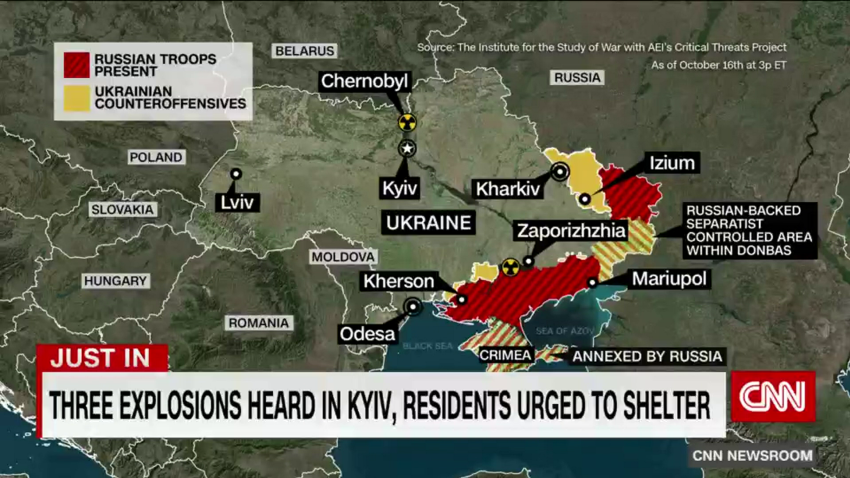
At least three explosions were heard in the Ukrainian capital at around 6:45 a.m. local time on Monday as a result of apparent Russian strikes, according to CNN’s team on the ground.
At least three explosions were heard in Kyiv at around 6:45 a.m. local time on Monday as a result of apparent Russian missile strikes, according to CNN’s team on the ground.
One of the blasts was in the Shevchenkivskyi district in the center of the Ukrainian capital, according to a Telegram post from Mayor Vitali Klitschko.
“All emergency services have been sent to the site,” Klitschko said. “Air raid sirens continue. Stay in your shelters!”
Watch:
Relations between Ukraine and Saudi Arabia are the “most meaningful” they’ve been in 30 years, Ukrainian President Volodymyr Zelensky said in his nightly address on Sunday.
“And for the past week, it is worth noting the strengthening of contacts with Saudi Arabia,” Zelensky said. “There are significant agreements. Among other things, this is the decision of the partners to provide a package of humanitarian support in the amount of $400 million. It is very important. Right now, we have the most meaningful relations with Saudi Arabia in 30 years.”
Zelensky’s remarks come after Saudi Arabia’s Crown Prince Mohammed bin Salman pledged $400 million in humanitarian aid to Ukraine on Friday.
On Sunday, Saudi Arabia’s Minister of Defense Khalid bin Salman affirmed the country’s support for Ukraine in a statement.
Grain deal: Zelensky also spoke about the Black Sea Grain Initiative, emphasizing that since July Ukraine has exported 8 million tons of food by sea.
He added that “60% of this volume was directed to Africa and Asia.”
Energy: He also addressed threats to Ukraine’s energy supply, stating that “due to the Russian missile terror in some cities and regions of Ukraine, energy workers have to limit the supply of electricity so that the entire system works stably.” He called for Ukrainian residents to limit electricity supply during peak hours.
Prisoners: In addition, Zelensky spoke about Ukrainians who had been captured by Russian forces.
“Everyone who captures the Russian military provides Ukraine with the opportunity to release our heroes,” he said. “We remember our people detained in Russia. We must liberate them, and we must liberate them all, leaving none to the enemy. But for this we need to capture the occupiers — as many as possible,” he said.

The Zaporizhzhia Nuclear power plant outside Enerhodar in the Zaporizhzhia region, Russian-controlled Ukraine, on October 14.
Part of the seized Zaporizhzhia nuclear power plant is controlled by armed Chechen forces, a Ukrainian military organization said Sunday.
The forces in question, the so-called Special Rapid Response Unit Akhmat, are led by a close ally of Russian President Vladimir Putin: Chechen Ramzan Kadyrov.
“It is known that a part of the station has recently been controlled by a Kadyrov gang … which placed equipment and weapons directly in turbine halls #1 and #2,” the Center of National Resistance said in a statement.
The center is a military organization designed to support and coordinate Ukrainian troops.
On Wednesday, the Chechen leader Kadyrov wrote in a Telegram post that his unit is in Enerhodar, a city adjacent to the Zaporizhzhia plant. He accused Ukrainians of firing “indiscriminately at the coastline of Enerhodar, its industrial area and the Zaporizhzhia NPP.”
Remember: The Zaporizhzhia plant, the largest nuclear complex of its kind in Europe, was seized by Russian forces at the start of the war.
In its statement, the Center of National Resistance also claimed that “Russia is trying to connect the Zaporizhzhia NPP to its power system as soon as possible.”
“The occupiers are hastily carrying out measures to convert the spent nuclear fuel storage system at the ZNPP to Russian standards, as well as adapting all nuclear reactors of the ZNPP to use Russian fuel assemblies,” the Center wrote.
CNN cannot independently verify these claims.
More context: The Chechen Republic is a region in Russia’s north Caucasus.
Russian forces fought a brutal war for control of the territory in the mid-1990s and the early 2000s. Kadyrov was once a guerrilla who fought against Russia before switching sides.
During the Second Chechen War, which coincided with the rise of Putin, Kadyrov helped Moscow wrest control of the Chechen Republic from separatist rebels.
Kadyrov has been accused by international and independent observers of gross human rights violations in his home territory and beyond. He leads sizeable paramilitary forces that — while formally a part of Russian security structures — have personal loyalty to him.
Saudi Arabia’s Minister of Defense Khalid bin Salman took to Twitter on Sunday to affirm the kingdom’s support for Ukraine and deny it is backing Russia in the war.
“We are astonished by the accusations that the kingdom is standing with Russia in its war with Ukraine. It is telling that these false accusations did not come from the Ukrainian government,” Khalid bin Salman tweeted.
He also retweeted an October 14 post from Ukrainian President Volodymyr Zelensky that thanked Saudi Crown Prince Mohammed bin Salman “for supporting Ukraine’s territorial integrity, resolution at the UN General Assembly” and for his willingness “to interact in the release of Ukrainian prisoners of war.” Zelensky also tweeted Saudi Arabia “agreed on the provision of macro-financial aid to Ukraine.”
US officials have argued that an OPEC+ decision to cut production by 2 million barrels per day will drive up oil prices and could end up helping Russia reap greater revenues from energy sales, thereby driving its war machine in Ukraine.
But Khalid bin Salman called the decision “purely economic” and shouldn’t be taken as a sign of “standing with Russia.”
“Although the OPEC+ decision, which was taken unanimously, was due to purely economic reasons, some accused the Kingdom of standing with Russia. Iran is also a member of OPEC, does this mean that the Kingdom is standing with Iran as well?” Khalid bin Salman tweeted Sunday.
On Wednesday, Saudi Minister of State for Foreign Affairs Adel al-Jubeir told CNN’s Becky Anderson his country partnered with Russia to slash oil production in order to stabilize markets and denied there were political motives behind the decision, which has enraged US leaders and sparked calls to rethink ties with Riyadh.
The Ukrainian government says 54 people died in a Russian assault on an apartment complex in the eastern city of Izium on March 9 — almost half of the building’s residents.
Entire families were killed in the attack, but their fates remained largely unknown until a few weeks ago. Ukrainian forces pursuing a counteroffensive reclaimed Izium after six months of Russian occupation, revealing a mass burial site on the outskirts of the city.
Most of the residents of the apartment building, 2 Pershotravneva street, were buried there among more than 400 graves, few with identifying marks other than numbers daubed on rough wooden crosses.
After speaking to a survivor, ex-residents and family members, and reviewing photos and video taken in the aftermath of the attack and following the town’s liberation, CNN can now tell the story of what happened at 2 Pershotravneva on that day.
Read the full report:
The fragile Black Sea grain deal will continue after Nov. 22, when it is set to expire, Ukrainian Infrastructure Minister Oleksandr Kubrakov said Sunday.
Kubrakov made the comments during a meeting with Turkish Defense Minister Hulusi Akar in Istanbul. They come after Russian officials, including President Vladimir Putin, cast doubt on the deal’s future this week.
“The participating parties of the Initiative — the UN, Turkey and Ukraine — expressed their readiness to continue operating and assured maximum efforts for its successful implementation. There is no doubt that the grain corridor will continue operating after Nov. 22,” Kubrakov said.
The minister also emphasized the importance of getting faster ship inspections by the Joint Coordination Center. This allows for “a significant increase in the volume of grain exports to the countries of Africa, Asia, and Europe and prevents the formation of inspection queues,” he said.
Some background: The Black Sea Grain Initiative — which was brokered by the UN and Turkey — was signed by representatives from Russia and Ukraine in July.
The agreement ended five months of Russian blockade, allowing ships carrying grain from Ukrainian ports in Odesa to navigate a safe corridor through the Black Sea, helping alleviate global food shortages.
Kubrakov said almost 7.7 million tons of agricultural products have been exported since the launch of the initiative, which “has stabilized food prices and countered the threat of global hunger.”
Russia casts doubt: Gennady Gatilov, Russia’s ambassador to the UN in Geneva, said this week that Russia could leave the deal, according to Reuters. Later, Putin weighed in, saying Moscow would shut the export corridors if they are used to carry out “terrorist attacks.”

White House National Security Advisor Jake Sullivan talks to reporters at the White House on September 30 in Washington, DC.
The US will make no distinction in its response to Russia using any form of nuclear weapon in its war with Ukraine, national security adviser Jake Sullivan told CNN Sunday.
Sullivan was responding to a hypothetical question from CNN’s Dana Bash on “State of the Union.” Bash asked whether the US would treat the so-called “tactical” use of a nuclear weapon — taking out a small target or detonating in the Black Sea, for example — any differently from wide-scale attacks.
“The use of a nuclear weapon on the battlefield in Ukraine is the use of a nuclear weapon on the battlefield in Ukraine, and we’re not going to slice the salami,” Sullivan said, adding: “The notion that somehow there’s differences in use here, I think, is a dangerous notion.”
“From our perspective, we believe it is incumbent upon the United States, working with our NATO allies and partners and other responsible countries around the world, including the likes of China and India, to send a very clear and decisive message to Russia that they should not contemplate the use of nuclear weapons in this conflict,” Sullivan added.

A screen grab from a video shows conductor Yuriy Kerpatenko conducting an orchestra.
A criminal investigation has been launched into the death of a Ukrainian orchestra conductor in Russian-occupied Kherson, according to Ukrainian officials.
The conductor was reportedly shot in his own home in Kherson by Russian forces “because he refused to cooperate with them,” a statement from the local prosecutor’s office said Friday.
The Ukrainian Ministry of Culture and Information Policy identified the conductor as Yuriy Kerpatenko of the Kherson Regional Philharmonic Orchestra.
According to the ministry, Kerpatenko had worked with the local philharmonic since 2000 and also served as the chief conductor of the Gilea Chamber Orchestra based at the Kherson Theater in 2004.
Paying tribute, the ministry said Kerpatenko had “openly demonstrated his civic position and refused to leave occupied Kherson.”
The prosecutor’s office did not specify when the killing happened, but said, “the deceased stopped contacting relatives in September of this year.”
“The Kherson Regional Prosecutor’s Office conducts procedural management in criminal proceedings initiated based on violations of the laws and customs of war, combined with intentional murder,” the statement added.
The Kherson region, seen as crucial to controlling Ukraine’s southern coast and access to the Black Sea, was one of the first areas to be occupied by Russian forces when they invaded more than six months ago.